
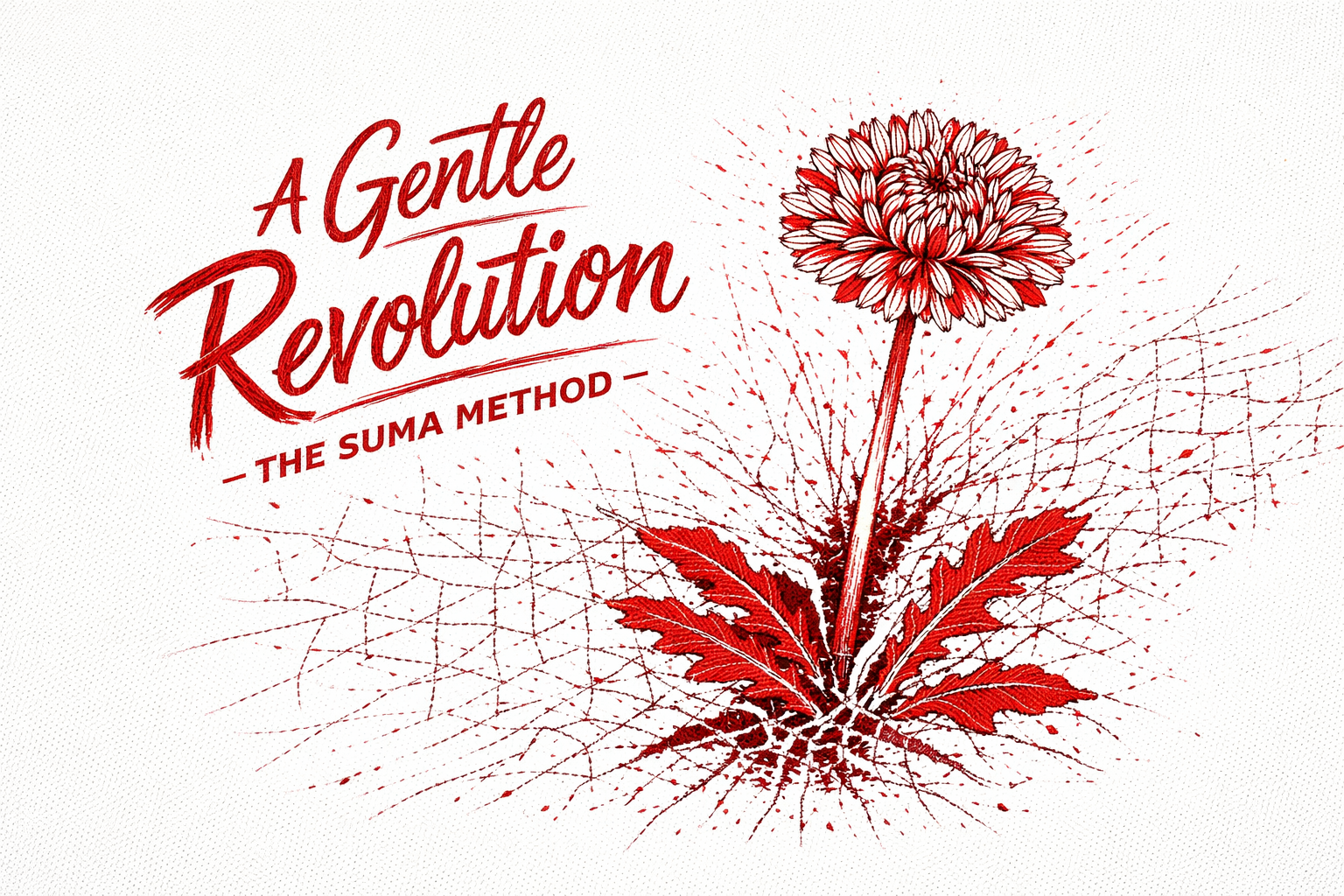
A Gentle Revolution
I’ve been a therapist for more than a decade now, and one of the things that has always puzzled me about human nature—or maybe about Western civilization more specifically—is our tendency to fight the natural order of things.
We seem almost compelled to wrestle with nature. To conquer it. To impose our will on it as proof that we can.
You see it everywhere. Luxurious green lawns carved into the desert where water barely wants to exist. Forests cleared so carefully that the wildness disappears and rose gardens bloom in tidy obedience. Rivers redirected. Hills flattened. Seasons ignored. The world reshaped until it reflects our ideas about how it ought to be.
Of course, there’s something admirable about that impulse. Civilization exists because humans refused to accept certain limits. We invented medicine, built cities, crossed oceans, and extended life expectancy because people dared to imagine a different world and then bent reality toward it.
But there is another side to this instinct. Sometimes our compulsion to conquer becomes so automatic that we forget to ask whether the battle itself makes sense.
And nowhere do I see that more clearly than in how we approach healing.
When someone is exhausted, burned out, barely functioning—when their inner world feels chaotic or fragile—we often encourage them to begin a campaign of self-improvement. Work harder. Think differently. Process your trauma. Confront your patterns. Dig deeper. Fix what’s wrong.
The wilderness inside them becomes a problem to tame.
But I’ve often wondered whether this approach misunderstands the moment.
When a forest has been scorched by fire, the first task is not landscaping. No one walks into a burned valley and immediately starts planting decorative shrubs or laying down gravel paths. The land has to recover first. Soil stabilizes. Small grasses return. Water finds its way back into the ground. Life reappears gradually, following patterns that ecosystems have been practicing for millions of years.
Nature doesn’t heal through force.
It heals through sequence.
Stability first. Growth later.
Yet in human life we often reverse the order. We ask people who are already depleted to begin intense emotional work. We ask people whose nervous systems are overwhelmed to analyze their childhood. We ask people who haven’t slept well in months to restructure their identity.
Then we wonder why it doesn’t work.
Or worse, we assume the person has failed.
Over the years I’ve come to believe that healing might require something quieter. Less heroic. Almost a little rebellious in its gentleness.
Instead of forcing transformation, what if we began by restoring the conditions that allow growth to happen naturally?
More rest. More safety. Small moments of pleasure. Time outside. Human connection that doesn’t require performance. A life that includes enough joy to remind the nervous system that the world is not only a place of danger.
It sounds almost too simple. Maybe even irresponsible.
But biology suggests otherwise.
When people experience safety and positive emotion, their minds become more flexible. Curiosity returns. Perspective widens. The nervous system loosens its grip on survival mode. The soil becomes fertile again.
Only then does deeper work become possible.
This sequence—stabilization before transformation—has quietly become one of the core principles of the framework I call the Suma Method. In Suma we begin not by digging immediately into trauma or dismantling identity, but by helping people stabilize their lives and increase everyday well-being. I sometimes call this happiness before deep work. When a person’s system has enough safety, vitality, and connection, insight becomes far less destabilizing and growth becomes sustainable.
This is not avoidance. It’s preparation.
Trying to rebuild your life while your system is still in crisis is like trying to grow vegetables in scorched earth. You might succeed through sheer effort for a little while, but the ground won’t support it for long.
Healing, like nature, follows a sequence.
First stabilization.
Then nourishment.
Then growth.
It’s a quiet kind of revolution to approach ourselves this way, especially in cultures that celebrate relentless productivity and heroic transformation. But perhaps the most radical thing we can do is stop treating our inner world like hostile territory.
Perhaps the wilderness inside us does not need conquering.
Perhaps it needs tending.
And if we allow the natural order of development to guide us—stability first, vitality next, insight later—we may discover that much of what we were trying to force eventually unfolds on its own.
Not because we conquered ourselves.
But because we finally gave the system enough life to grow.